
A RED SOL colony on a lake shore, surrounded by violet-canopied forest, with the colony ship at its centre

Forged Flow — In development

A colony sim where everything revolves around the colonists.

A living alien world, simulated to the household. Land on a procedurally generated planet, build the bones of a colony — power, water, life support — then found districts and watch a society grow inside them across generations.

StatusIn development
EngineGodot 4.7 · 3D
WorldProcedural, seeded
PlayersSingle-player · PC
StudioForged Flow, AU

The pitch

Most colony sims treat people as resources with a happiness bar.

RED SOL treats them as the simulation.

Every colonist has one of twelve personality archetypes, a wealth tier, a household and a daily routine driven by a global clock. They work shifts, sleep, eat, commute and take their leisure where it suits them. They pair up, form households, raise children, send them through school, and eventually watch them move out and start households of their own.

What they want — across ten categories from nourishment and connection to culture, nature and faith — is what pulls the economy forward. Wants create demand; demand opens businesses; businesses need resources you mine, refine, manufacture or import. As colonists grow wealthier they aspire to higher-tier experiences that are hungrier for power and materials, and the whole colony has to climb to meet them.

You place the civic backbone directly: power, life support, clinics, schools. Everything else you found as districts — give an area a character, and the colony fills it to demand, resource availability and profit: several coffee shops, competing gyms, the occasional business that fails and closes. It grows with you rather than only because of you.

And it all happens on a planet that was alive before you arrived — nine biomes, wandering herds and flocks, megafauna, weather and wind, rivers and lakes, all generated from a seed and different every game.

Comparables

Depth
Oxygen Not Included
Frontier
Surviving Mars
Growth
Cities: Skylines
Districts
Manor Lords
Look
Full 3D, day & night, seeded worlds

Design pillars

Nine systems, all pointed at the colonists.

Every system was designed and proven in a working prototype before it was written into the engine.

01

Living colonists

Shift-based daily routines on a global clock — work, sleep, eat, commute, relax. Track one and you can follow their whole day.

02

Families & generations

Child, teen, adult, senior. Colonists pair up, form households, have children — and the demographic pipeline reshapes the colony over generations.

03

Personality & wants

Twelve archetypes — Homebody, Socialite, Thrill-seeker, Scholar, Gourmand — weight each colonist's wants across ten categories. Happiness is how well their wants are met, not a global average.

04

A real economy

Wages circulate in a closed credit economy; money is only created or destroyed at the off-world boundary. Every business runs its own P&L, and rising colonist wealth demands higher-tier, hungrier goods — the flywheel that drives everything.

05

A living alien world

Nine exotic biomes generated from a seed. Herds and flocks that flee your machines, megafauna you'd rather not disturb, rivers, weather, wind and a full day/night cycle.

06

Production chains & logistics

ONI-deep resource chains moved over real networks — pipe and conveyor mains, hauler drones, maglev lines and a working spaceport. Distance is a cost; transport is the answer.

07

Real-time power grid

Per-building hourly load profiles, solar and baseload generation, battery storage, and brownout load-shedding by priority — life support first, discretionary last.

08

Districts & organic growth

You place civic buildings and found districts with a character. The colony fills them to demand and profit, with real variance. Businesses that can't make it work shut down.

09

An orbital endgame

Spaceflight burns colony output — fuel, crew, materials — and pays back in things the ground can't give you. The road leads to asteroid capture, orbital industry, and the wormhole. And no, you don't terraform: the planet was alive first.

Media

From the game.

Captured from the current build — full 3D, day/night lighting, procedural terrain.

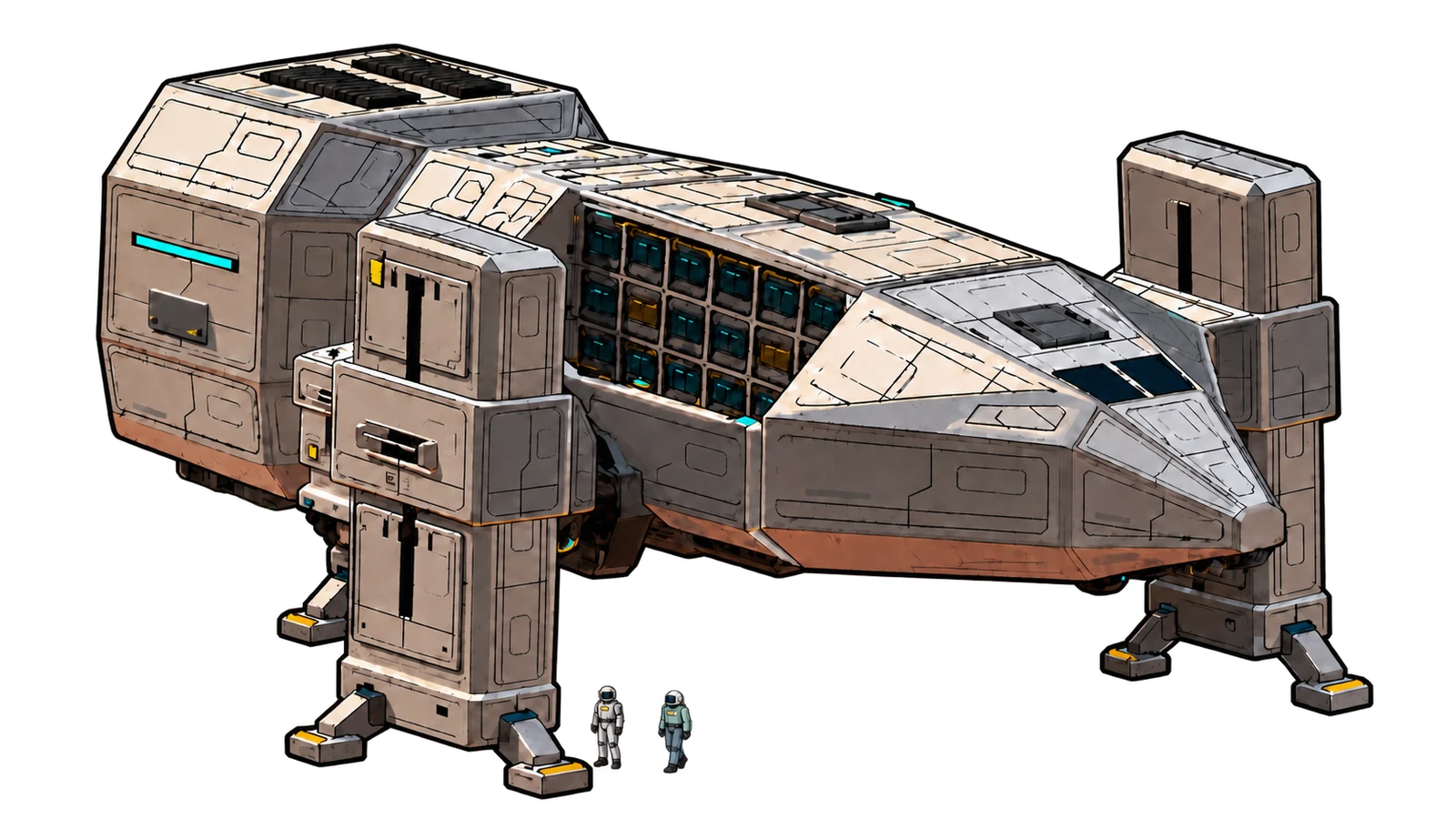
The colony ship landed among alien trees, with rovers and defence emplacements deployed around it
A young colony spread along a lake shore beneath violet-canopied forest
An industrial refinery with its processing tower, tanks and conveyor taps
The mobile miner working through the night by its own floodlights
The colony ship crossing a snowbound biome dotted with spiral-banded trees
The spaceport landing complex with pads, service buildings and drones
A red canyon biome with banded spiral flora at dusk

By the numbers

The in-game encyclopedia already runs to 407 entries.

Every one generated from the same data tables the simulation runs on, with imagery rendered by an automated photo booth. When a row is added to the game, the encyclopedia — and every system that consumes that category — picks it up automatically.

Buildings137
Research nodes119
Resources45
Vehicles & drones21
Native species17
Biomes9
The RED SOL colony encyclopedia chapter list: 407 entries across buildings, resources, crops, flora, fauna, megafauna, threats, vehicles, weapons, weather, disasters, biomes, research and orbital prefabs

Under the hood

Built to hold thousands of colonists.

Simulation depth is only worth anything if it scales, so the architecture was settled before the systems were built.

Agent level-of-detail. Only colonists on screen or actively tracked run at full fidelity. Everyone else advances through scheduled events and cheap per-sol rolls — travel becomes a duration rather than a walk. Fauna use the same trick: the herd is the agent, never the animal.

A 2.5D world. The sim runs on a 2D grid; terrain height is a render and cost attribute, never a third simulation dimension. The planet is pure and deterministic from its seed — generate on demand, simulate locally, render what's near, with chunks streaming around the camera.

Data-driven content. Resources, crops, meals, buildings, vehicles, fauna, personalities and research all live in data tables keyed by id and tagged by tier. Code loops over categories and never references a specific entry — new content is a new row, not a code change, which makes the game mod-friendly by default. Referential integrity is validated on every boot.

Tested like software. Automated probes exercise the spaceport, rail freight and terminal systems on every round; a standing model audit checks all 300+ art assets; the in-game encyclopedia's imagery is generated by an automated photo booth.

At a glance

Engine
Godot 4.7, GDScript
Renderer
Forward+ (Vulkan), full 3D
Physics
Jolt — effects only, sim stays deterministic
World
1000×1000 seeded procedural terrain
Content
CSV-driven, validated at boot, moddable
Target scale
1,000+ colonists

Development

Where it stands.

Built in vertical slices — one system fully working and visible before the next one starts.

  1. Done

    The core simulation

    Colonists, families, wants and happiness; the closed economy with per-business P&L; districts; the research tree; the real-time power grid; health, weather and disasters. All eleven planned slices, landed and playable.

  2. Done

    The 3D world

    The renderer was rebuilt in full 3D with day/night lighting, then the world went procedural — seeded 1000×1000 terrain, nine biomes, lakes and rivers, streamed chunks, slope-aware foundations.

  3. Now

    The living frontier

    Native fauna and megafauna, threats and defence, maglev and monorail transit, the spaceport and its fleet, the in-game encyclopedia — refined through 250+ verified playtest-and-fix rounds and counting.

  4. Next

    Survey, balance, and the road to a build

    Survey and fog-of-war, economy balancing across the full arc, and packaging toward a build that can be put in front of players and partners.

The studio

Forged Flow.

Forged Flow is an independent Australian game developer. RED SOL is its first title — a long-form simulation project built deliberately, in vertical slices, with each system designed and specified before it's written into the engine.

The result is a project unusually far along for a studio its size: the full design is documented across a canonical spec set, every major system is implemented and playable, and development runs on a disciplined loop of playtest rounds, automated probes and per-round verification — more than 250 rounds deep.

Fact sheet

Title
RED SOL
Developer
Forged Flow
Based
Australia
Team
Solo developer
Genre
Colony simulation / management
Players
Single-player
Platform
PC — further platforms TBC
Status
In development
Release
TBA

Contact

Publishing & press.

Open to conversations with publishers, and happy to send a longer design document, a build walkthrough, or answer anything about the simulation architecture.

hello@forgedflow.com.au